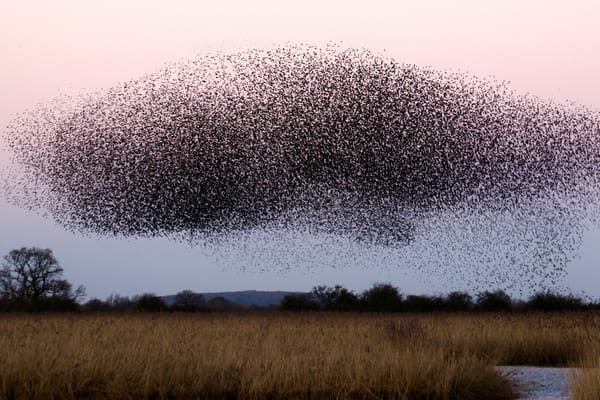
The Lesson from Minneapolis
This is how we win our country


To recap, in case you’re new or missed my previous announcement: I’m in the process of splitting Nine Lives into two newsletters: one of which (Nine Lives) will be more formal essays, a few times a year, archived on the site, and one of which (News & Notes) will be newsier, more casual updates, once or twice a month, available only by email. This is one of the former.
The federal government of America has gathered up (is still gathering up) the most sadistic bullies in our midst and given them license to go to war with the American citizenry. These federal agents, from both ICE and CBP, have escalated from kidnapping and killing people in concentration camps to executing people on the street.
And yet. The city of Minneapolis — the current ground zero for the fascist occupation of terror — is full of furious and grieving people doing heroic things. There is hope for all of us, there.
I have two pieces for you to read that illustrate this in detail. (I’ve read several dozen others, a few of which are linked later, but I think these are the two best.) Do please read at least these two, because I want to point out a couple of things afterward.
First is an article in The Atlantic by reporter Robert F. Worth: Welcome to the American Winter
Next is a piece by one of my favorite journalists, labor reporter Hamilton Nolan: Intolerable Things
Okay, now that you’ve read those, I want to draw your attention to the fact that people on the ground in Minneapolis are comparing it to “a politically torn, unstable country in a transitional period before full-blown war with a repressive government”. These are journalists and refugees who’ve seen it before, and they’re referencing Ukraine in 2013, Somalia in 1989, Egypt in 2011.
If you want to get a sense of what to expect for America in 2026, look at the linked Wikipedia articles above. History professor (and national treasure) Heather Cox Richardson has been warning us: “It’s going to get worse before it gets better.”
That’s the bad news. The good news is that, by all accounts, choosing to invade Minneapolis specifically (in winter, no less!) was a colossal tactical error by the fascists.
One, because Minneapolis has a pre-existing level of community organization that might be unrivaled anywhere in the country. That peer-to-peer network was largely built during and after the George Floyd protests, but it also draws on just the basic sort of neighborliness that is necessary to regularly survive winters of such killing cold.
Two, because Minnesota may be a “blue city” but it’s also heartland Midwestern America, majority white, majority Christian. Videos of these people, the things they say and do, will resonate with moderate and even many conservative people across the country.[1]
What ordinary Minneapolitans are saying, over and over, is variations on: “I’m not political, I’ve never been a protester, but I can’t just stand by and watch these atrocities.”
What ordinary Minneapolitans are doing is saving lives and protecting the integrity of families. By taking away the ability of federal thugs to operate in secret, by tracking and observing, by warning targets, by drawing crowds to shame and protest and bear witness, they are throwing sand in the gears, making ICE and CBP markedly less effective, significantly reducing the number of abductions. Here is a Minneapolis sociologist whose field of expertise is violence, on how and why this strategy is working.[2]
And by taking videos of agents’ brutality and smug disregard for civil rights — in numbers that make it impossible for any decent citizen, no matter how “low-information”, to dismiss — Minneapolitans are shifting the narrative across the country and eroding Trump’s base of support. All of which is exactly what the political scientists who study resistance movements say is the path to success.
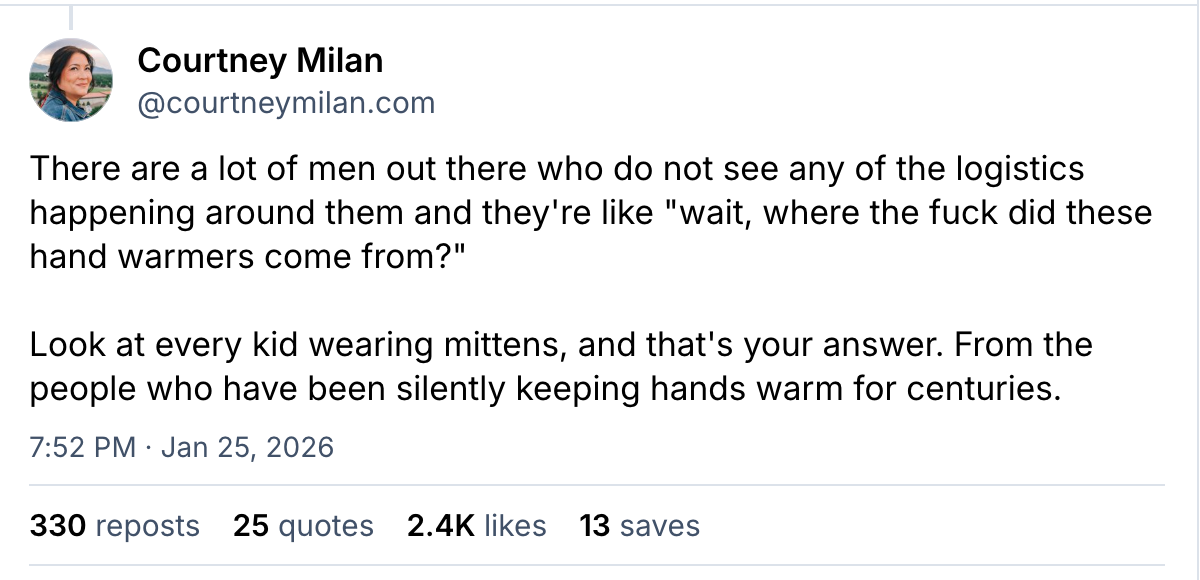
And let me reiterate one more time that none of this would be possible if it weren’t for some really excellent decentralized organization and logistics. People who are moved to help have self-sorted by neighborhood, started up hyperlocal group Signal chats, organized who’s going to do what — who’ll deliver food to brown-skinned people afraid to leave their homes, who’ll stand watch outside the elementary school so brown kids don’t get abducted, who’ll coordinate the distribution of 3D-printed whistles being donated from across the country, who’ll take shifts following ICE vehicles and reporting locations, who’ll sit at home verifying license plates against the crowdsourced database, who’ll make supply runs to hardware stores and Costco for goggles and gas masks and hand warmers.
A couple of days ago, the corner of Bluesky that I occasionally read erupted in jeers at the screenshot of some right-wing dude’s X-Twitter post in which he maintained that the sheer quantity of free hand warmer packets, winter clothing, and coffee being shared and distributed amongst the Minneapolis observers and protestors was evidence of “professional-grade logistics” and “bankrolling”.
Bluesky was just like, “Lol no it’s just women, getting shit done like always.”
Front-line observers are important, but they are only the tip of a mostly-invisible iceberg of resistance. Wars are won on supply chains and communications — this is the wisdom of generals from Sun Tzu to Eisenhower.
And this is a war — a war of kindness and empathy and absolute righteous fury against sadism and cruelty and entitled white supremacy. One side is deploying lethal weapons (some so terrible that they are outlawed in international wars), brutalizing even small children, and executing people who object to their indiscriminate kidnappings, torture, and murder.
The other side is yelling. And blowing warning whistles and handing out food and hand warmers. And they are putting their bodies and lives in danger for the civil rights of both their immigrant neighbors and every single American citizen in the country.
This non-violence is not weak, it is not useless. It is utterly valiant (You have two people in a confrontation, one using guns and tear gas, the other using a whistle. Which is more brave?) and utterly essential. If Alex Pretti had drawn his (legal) handgun and attacked the federal agents who were (illegally) assaulting him and others, he would still have died — but his death would have had far less national impact, because it would be easier for people to believe the government’s lies that he was a domestic terrorist intent on assassination, rather than a nurse trying to aid a tear-gassed woman.
After Renee Good’s murder, federal agents kept confronting observers with variations on the line “Haven’t you learned your lesson yet?” They fully expected the people of Minnesota to back away in fear for their own lives, and let them run rampant across the city, unopposed.
But the murder overwhelmingly had the exact opposite effect. After Renee Good, people who’d thus far been watching from the sidelines showed up in droves to help. After Alex Pretti, they doubled down again; volunteer trainers and organizers have reported tens of thousands of new people showing up in January alone. With each murder, ICE and CBP are recruiting for the resistance.
So yes, Minneapolitans have learned their lesson, though it’s not the one the white nationalists would prefer. They are learning that none of us are safe, that there is no boundary that will not be crossed, that the horror will not stop unless enough ordinary people organize together and stop it.
When I rebooted Nine Lives a few years ago, I decided I would make the chore of finding something to visually illustrate the essays more fun for myself by always and only choosing animal photos. Sometimes this rule works out better than others.
This time, I think it is perfect: a line of tiny creatures, all nearly invisible in their native environment, yet the collective effects of their efforts blaze out like a million little green flags. Leafcutter ants are endemic where I live now; I’ve seen them strip an eight-foot tall hibiscus bush completely bare in just two short summer nights. A single colony has literally millions of ants, all self-organized (the “queen” doesn’t tell anyone what to do, she just makes more ants), and they are absolutely a stunning force of nature. As a vegetable gardener, I can tell you from first-hand experience, they are nearly impossible to defeat.
Helping from elsewhere
Since Alex Pretti’s execution — in addition to reading about the Minneapolis resistance and writing this piece — I’ve been working my way through Minnesota author Naomi Kritzer’s “How to Help If You Are Outside Minnesota” page. So far this week I’ve donated $100 to resistance groups; next is yelling at my Senators again, followed by emailing Target and the other Minnesota corporations who have collaborated with ICE.
Yesterday I saw several people from Minneapolis say that the biggest, most urgent need right now is for rent assistance for the people who are (rightfully) too terrified to leave their homes to go to work. Only a small percentage are even in the country illegally (which remember is just a misdemeanor, like exceeding the speed limit); most are American citizens by oath or by birth, but their brown skin makes them a target. The Minneapolis-based Immigration Rapid Response Network is collecting donations for rent assistance here.
These are the things I can do from outside the country. If I lived anywhere in the United States right now, I would be doing so much more: I would be building trust networks and Signal group chats with likeminded neighbors. I would be stockpiling anti-tear gas equipment like respirators and goggles, on the understanding that if I and my neighbors didn’t need them, someone else would.[3] I would either be trying to travel to Minneapolis to take notes from their training and experience, or contributing to send someone else from my community — and if I couldn’t go myself, I would be hoovering up every bit of online training and instruction that I could find.
Because this is going to get worse before it gets better; because it’s going to happen somewhere else, and somewhere else, and somewhere else after that, and the way to win against fascism is for people all across the country to be as organized and courageous and resilient as Minneapolis.
Addendum
If you are a paying subscriber to Nine Lives, I truly appreciate your support and it has meant a lot to me. But for 2026 I will not be asking for further donations; please spend that money instead supporting the people in places like Minneapolis who are directly resisting the violent fascists.
What I will ask is that if you learned something from this article, or if it made you think differently or emotionally moved you in any way, please forward or share it.
I‘m not asking merely for the sake of my own ego, but because I’m doing my best to help bend the arc of the moral universe toward justice in whatever ways I can, and writing is arguably the only thing I’ve ever been really good at.
I chose two years ago to leave Substack (because it’s largely owned by an openly fascist billionaire, it supports white supremacists, and it is a giant pile of enshittification waiting to happen), but the effect of that has been that it’s now much more difficult for me to get new eyeballs on anything I write. So if you think I’ve succeeded in saying something worthwhile, please pass it on. And thank you for reading.
Somewhat ironically, the fact that a lot of non-white residents and citizens are hiding indoors so they don’t get abducted means that an even larger percentage of people in these videos are white. ↩︎
This is adjacent to the sociological phenomenon I wrote about in Toward a Spiral of Sound. ↩︎
See also the safety practices I previously compiled in How to Survive a Protest. ↩︎
Photo credit: 1